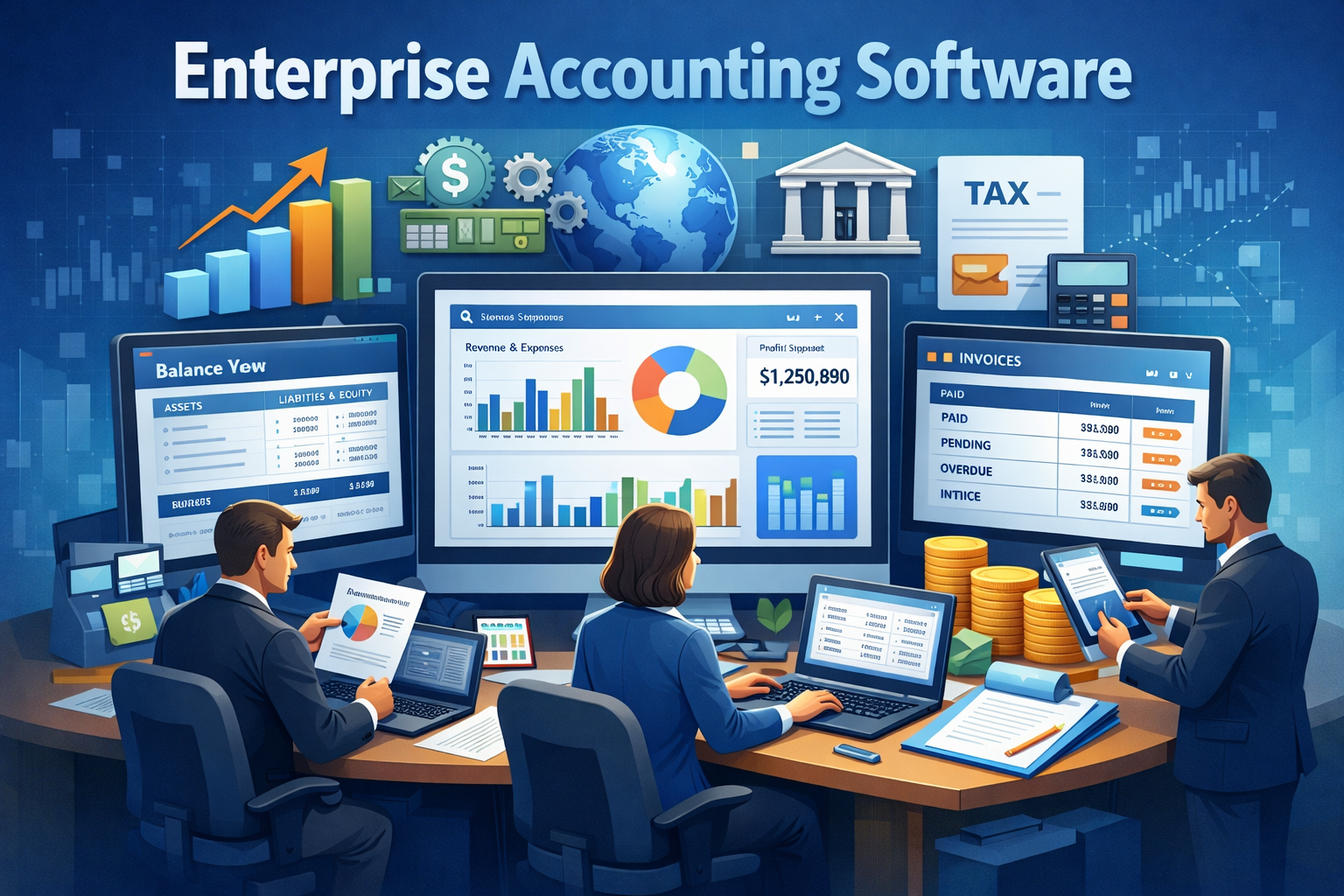
Enterprise accounting software plays a critical role in how large organizations manage finances, ensure compliance, and make data-driven decisions. As companies scale, spreadsheets and basic accounting tools quickly become insufficient. Modern enterprises require robust, secure, and scalable accounting systems that integrate seamlessly with other business operations.
This in-depth guide explores the best enterprise accounting software available in 2026, compares leading platforms, and explains how to choose the right solution for your organization. The goal is to provide practical, unbiased, and advertiser-friendly information that helps decision-makers confidently evaluate their options.
Disclaimer: This article is for general informational and educational purposes only. It does not constitute financial, legal, or accounting advice. Organizations should consult qualified professionals before selecting or implementing enterprise accounting software.
Table of Contents
What Is Enterprise Accounting Software?
Enterprise accounting software is a comprehensive financial management system designed for large organizations with complex accounting needs. Unlike small business accounting tools, enterprise solutions support:
- Multi-entity and multi-currency accounting
- Advanced compliance and audit requirements
- High transaction volumes
- Custom workflows and role-based access
- Deep integrations with ERP, CRM, HR, and supply chain systems
These platforms are typically used by mid-market to large enterprises, multinational corporations, and regulated industries.
Why Enterprise Accounting Software Matters
For large organizations, accounting is more than bookkeeping. It directly impacts governance, risk management, and strategic planning.
Key Benefits for Enterprises
- Financial visibility: Real-time insights across departments and subsidiaries
- Regulatory compliance: Built-in controls for GAAP, IFRS, SOX, and tax regulations
- Operational efficiency: Automation reduces manual errors and closing time
- Scalability: Systems grow alongside business expansion
- Data security: Enterprise-grade security and audit trails
In 2026, cloud adoption, AI-assisted reporting, and real-time analytics are now standard expectations rather than premium features.
Key Features to Look for in Enterprise Accounting Software
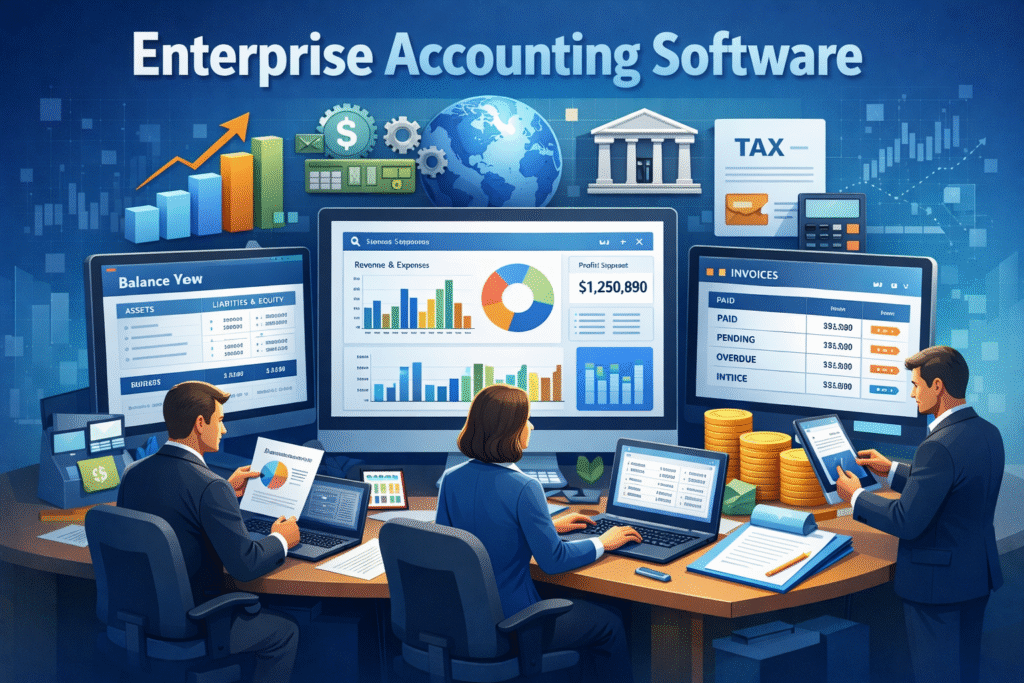
Before reviewing specific platforms, it’s important to understand the core features that define high-quality enterprise accounting software.
1. General Ledger and Financial Reporting
A robust general ledger is the foundation of enterprise accounting. Look for:
- Configurable chart of accounts
- Real-time financial statements
- Consolidation across multiple entities
- Custom reporting and dashboards
2. Compliance and Audit Controls
Enterprises often operate in regulated environments. Essential compliance features include:
- Audit trails and change logs
- Segregation of duties
- Support for GAAP, IFRS, and local tax rules
- Automated compliance reporting
3. Multi-Entity and Global Capabilities
For organizations operating across regions:
- Multi-currency accounting
- Intercompany transactions
- Localized tax and reporting rules
- Global consolidation tools
4. Integration and Automation
Enterprise accounting software should integrate with:
- ERP systems
- Payroll and HR platforms
- CRM and billing tools
- Banking and payment gateways
Automation features such as recurring journal entries and AI-assisted reconciliation can significantly reduce manual workload.
5. Security and Access Control
Security is non-negotiable at the enterprise level:
- Role-based permissions
- Encryption of financial data
- Compliance with industry security standards
- Disaster recovery and backup options
Intelligent ERP: A Comprehensive Guide to Smarter Enterprise Resource Planning in 2026
Best Enterprise Accounting Software in 2026
Below is a detailed analysis of the most widely adopted and trusted enterprise accounting platforms in the current market. These solutions are evaluated based on functionality, scalability, reputation, and suitability for large organizations.
1. Oracle NetSuite Financial Management
Best for: Global enterprises and fast-growing organizations
Oracle NetSuite remains one of the most popular cloud-based enterprise accounting platforms. It offers a unified system that combines accounting, ERP, and financial planning.
Key Features
- Real-time general ledger and financial reporting
- Multi-subsidiary and multi-currency support
- Advanced revenue recognition
- Built-in tax management and compliance tools
Pros
- Strong global accounting capabilities
- Scalable for rapidly growing enterprises
- Extensive reporting and analytics
Cons
- Higher implementation and licensing costs
- Requires training for new users
NetSuite is particularly well-suited for enterprises seeking a single, cloud-native financial system.
2. SAP S/4HANA Finance
Best for: Large corporations with complex financial operations
SAP S/4HANA Finance is an enterprise-grade solution designed for high-volume, mission-critical environments. It is widely used by multinational corporations and regulated industries.
Key Features
- In-memory financial processing
- Advanced financial planning and analysis
- Real-time compliance monitoring
- Deep integration with SAP ERP ecosystem
Pros
- Exceptional performance at scale
- Strong compliance and governance controls
- Trusted by global enterprises
Cons
- Complex implementation process
- Significant upfront investment
SAP S/4HANA Finance is ideal for organizations already using SAP products or managing extremely complex financial structures.
3. Microsoft Dynamics 365 Finance
Best for: Enterprises using Microsoft’s business ecosystem
Microsoft Dynamics 365 Finance combines enterprise accounting with operational insights, making it a strong choice for organizations invested in Microsoft technologies.
Key Features
- Advanced budgeting and forecasting
- Automated tax calculations
- Built-in analytics with Power BI
- Integration with Microsoft 365 and Azure
Pros
- Familiar interface for Microsoft users
- Strong reporting and analytics tools
- Flexible deployment options
Cons
- Customization may require technical expertise
- Licensing complexity for large deployments
Dynamics 365 Finance is often chosen by enterprises seeking tight integration with Microsoft tools.
4. Workday Financial Management
Best for: Service-based and people-centric enterprises
Workday Financial Management is known for its modern interface and strong focus on real-time financial visibility. It is particularly popular among enterprises in education, healthcare, and professional services.
Key Features
- Unified financial and workforce data
- Real-time reporting and dashboards
- Automated accounting processes
- Strong audit and compliance controls
Pros
- Intuitive user experience
- Cloud-native architecture
- Strong analytics capabilities
Cons
- Limited customization compared to legacy systems
- Higher cost for smaller enterprises
Workday is a strong option for organizations prioritizing usability and integrated workforce insights.
5. Sage Intacct
Best for: Mid-to-large enterprises seeking flexibility
Sage Intacct is a cloud-based accounting platform known for its strong core financials and modular approach.
Key Features
- Multi-entity and dimensional accounting
- Automated revenue recognition
- Customizable financial reporting
- Open API for integrations
Pros
- User-friendly interface
- Strong reporting capabilities
- Flexible and scalable
Cons
- Limited full ERP functionality
- May require third-party integrations
Sage Intacct is often selected by growing enterprises that need advanced accounting without a full ERP overhaul.
Comparison Table: Enterprise Accounting Software Overview
| Software | Deployment | Best For | Scalability | Global Support |
|---|---|---|---|---|
| Oracle NetSuite | Cloud | Global growth | High | Yes |
| SAP S/4HANA Finance | Cloud/On-Premise | Large corporations | Very High | Yes |
| Microsoft Dynamics 365 Finance | Cloud/Hybrid | Microsoft users | High | Yes |
| Workday Financial Management | Cloud | Service enterprises | High | Moderate |
| Sage Intacct | Cloud | Mid-market enterprises | Moderate-High | Moderate |
How to Choose the Best Enterprise Accounting Software
Selecting enterprise accounting software is a strategic decision with long-term impact.
Step 1: Assess Business Complexity
Consider:
- Number of entities and subsidiaries
- Geographic presence
- Regulatory requirements
Step 2: Define Integration Needs
Ensure compatibility with existing systems such as ERP, CRM, payroll, and banking platforms.
Step 3: Evaluate Total Cost of Ownership
Look beyond licensing fees:
- Implementation and customization costs
- Ongoing support and training
- Future scalability expenses
Step 4: Prioritize Security and Compliance
Verify that the software meets industry standards and local regulations relevant to your business.
Common Challenges in Enterprise Accounting Implementation
Even the best software requires proper planning.
Typical Challenges
- Data migration from legacy systems
- User adoption and training
- Customization complexity
- Integration delays
How to Mitigate Risks
- Involve stakeholders early
- Work with certified implementation partners
- Allocate sufficient training resources
FAQs About Enterprise Accounting Software
What is the difference between enterprise and small business accounting software?
Enterprise accounting software supports complex operations such as multi-entity consolidation, advanced compliance, and large transaction volumes, while small business tools focus on basic bookkeeping.
Is cloud-based enterprise accounting software secure?
Reputable providers use enterprise-grade security, encryption, and compliance certifications. Cloud security often exceeds that of on-premise systems when properly managed.
How long does implementation typically take?
Implementation timelines vary widely, ranging from a few months to over a year, depending on system complexity and customization needs.
Can enterprise accounting software support international operations?
Yes. Most leading platforms offer multi-currency, multi-language, and localized tax support for global businesses.
Pros and Cons of Enterprise Accounting Software
Pros
- Centralized financial control
- Improved accuracy and compliance
- Real-time financial insights
- Scalable for long-term growth
Cons
- High initial investment
- Longer implementation timelines
- Requires user training and change management
Future Trends in Enterprise Accounting Software
In 2026, enterprise accounting continues to evolve with technology.
Key Trends to Watch
- AI-driven forecasting and anomaly detection
- Real-time financial close processes
- Deeper ESG and sustainability reporting
- Increased automation of compliance tasks
Enterprises that adopt forward-looking platforms are better positioned to adapt to regulatory and market changes.

Conclusion: Choosing the Right Enterprise Accounting Software
The best enterprise accounting software is not a one-size-fits-all solution. Platforms like Oracle NetSuite, SAP S/4HANA Finance, Microsoft Dynamics 365 Finance, Workday Financial Management, and Sage Intacct each serve different enterprise needs.
Key takeaways:
- Focus on scalability, compliance, and integration
- Evaluate total cost and long-term value
- Prioritize security and reporting capabilities
By carefully aligning software capabilities with organizational requirements, enterprises can build a reliable financial foundation that supports growth, compliance, and informed decision-making well into the future.