Cloud adoption among small businesses has accelerated rapidly over the last few years. From accounting software and customer relationship management (CRM) tools to data storage and remote collaboration platforms, the cloud is now central to daily operations. However, as reliance on cloud services increases, so do cybersecurity risks. Data breaches, ransomware attacks, misconfigurations, and compliance failures can be devastating for small businesses with limited IT budgets and personnel.
That’s why choosing the right cloud security provider in 2026 is no longer optional—it’s a critical business decision.
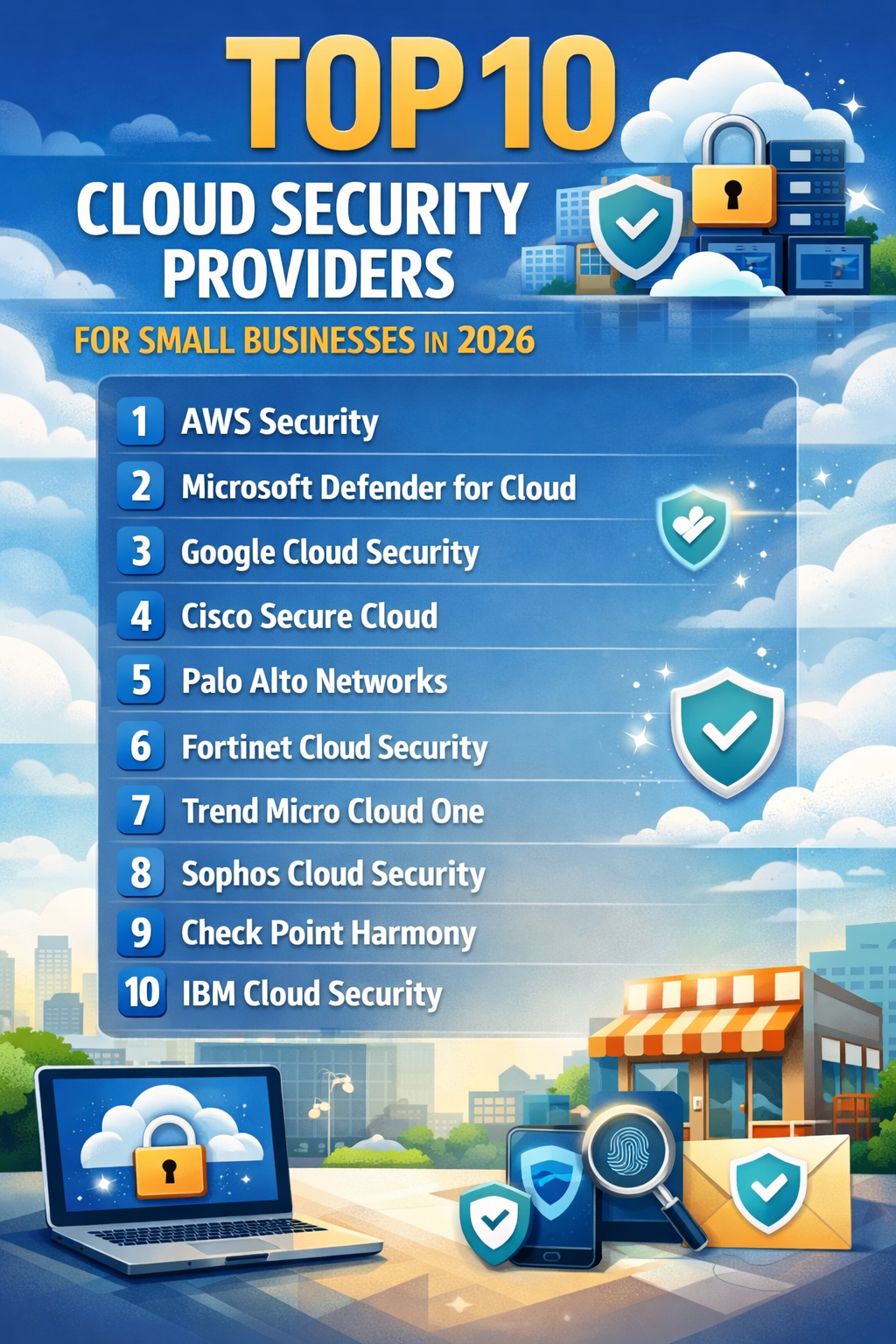
This in-depth guide explores the Top 10 Cloud Security Providers for Small Businesses in 2026, focusing on real-world usability, affordability, scalability, and compliance. The article is designed to help business owners, IT managers, and decision-makers understand which solutions best protect cloud-based infrastructure without unnecessary complexity or cost.
Why Cloud Security Matters for Small Businesses in 2026
Small businesses are increasingly targeted by cybercriminals. Contrary to popular belief, attackers often prefer smaller organizations because they typically have fewer defenses in place.
Key Cloud Security Challenges Facing Small Businesses
- Limited in-house cybersecurity expertise
- Budget constraints
- Complex regulatory requirements
- Growing attack surface due to remote work
- Misconfigured cloud environments
According to recent industry reports, over 40% of cyberattacks now target small and medium-sized businesses, and cloud misconfigurations remain one of the leading causes of data exposure. Cloud security providers address these risks by offering tools and services such as threat detection, access control, data encryption, compliance monitoring, and incident response.
How We Evaluated the Best Cloud Security Providers
To ensure this list delivers real value, each provider was evaluated based on the following criteria:
- Suitability for small businesses
- Ease of deployment and management
- Pricing transparency and affordability
- Security features and threat coverage
- Compliance support (GDPR, HIPAA, SOC 2, etc.)
- Customer support and documentation
- Reputation and industry trust
The goal is not to rank the “biggest” providers, but the most practical and reliable cloud security solutions for small organizations in 2026.
Table of Contents
1. Palo Alto Networks Prisma Cloud
Best for comprehensive cloud-native security
Palo Alto Networks’ Prisma Cloud is widely regarded as one of the most powerful cloud security platforms available. While traditionally favored by large enterprises, Prisma Cloud has expanded its offerings to better serve small and mid-sized businesses.
Key Features
- Cloud Security Posture Management (CSPM)
- Cloud Workload Protection (CWPP)
- Identity and access risk analysis
- Infrastructure-as-Code (IaC) scanning
- Compliance monitoring and reporting
Pros
- Enterprise-grade protection
- Strong threat intelligence
- Supports multi-cloud environments
Cons
- Higher learning curve
- Pricing may be high for very small teams
Prisma Cloud is ideal for small businesses planning to scale quickly and needing advanced security without switching platforms later.
2. Microsoft Defender for Cloud
Best for Microsoft-centric small businesses
Microsoft Defender for Cloud is a natural choice for organizations already using Azure, Microsoft 365, or Windows-based environments.
Key Features
- Continuous security assessment
- Threat detection powered by AI
- Secure score and recommendations
- Built-in compliance tools
- Hybrid and multi-cloud support
Pros
- Deep integration with Microsoft ecosystem
- Familiar interface
- Flexible pricing model
Cons
- Less intuitive for non-Microsoft environments
- Advanced features may require configuration expertise
For small businesses running on Microsoft cloud services, Defender for Cloud offers excellent value and seamless integration.
3. AWS Security Hub
Best for AWS-based small businesses
AWS Security Hub centralizes security alerts and compliance checks across AWS services. It’s designed to give small teams visibility without overwhelming them.
Key Features
- Centralized security findings
- Automated compliance checks
- Integration with AWS native tools
- Partner ecosystem support
Pros
- Native AWS integration
- Pay-as-you-go pricing
- Scales with business growth
Cons
- Limited outside AWS
- Requires familiarity with AWS services
If your business runs primarily on Amazon Web Services, Security Hub provides essential cloud security visibility at a reasonable cost.
4. Trend Micro Cloud One
Best for workload and application security
Trend Micro Cloud One focuses on protecting cloud workloads, containers, and applications across multiple cloud platforms.
Key Features
- Runtime application protection
- Malware and ransomware defense
- File integrity monitoring
- Vulnerability scanning
Pros
- Lightweight deployment
- Strong threat detection
- Multi-cloud compatibility
Cons
- Less emphasis on governance features
- Interface can feel technical
Cloud One is well-suited for small businesses running modern applications or containers that need strong runtime protection.
5. Check Point CloudGuard
Best for network and compliance security
Check Point CloudGuard provides consistent security across cloud networks with a focus on compliance and threat prevention.
Key Features
- Network security and firewalls
- Threat prevention
- Compliance automation
- Posture management
Pros
- Strong network-level security
- Reliable compliance reporting
- Trusted security brand
Cons
- Setup may require assistance
- Cost can increase with scale
CloudGuard works well for small businesses handling sensitive data or operating in regulated industries.
6. Sophos Cloud Optix
Best for simplicity and affordability
Sophos Cloud Optix is designed with smaller IT teams in mind, offering strong cloud security without excessive complexity.
Key Features
- Cloud posture management
- Asset discovery
- Misconfiguration detection
- Risk prioritization
Pros
- User-friendly dashboard
- Affordable pricing
- Good customer support
Cons
- Limited advanced analytics
- Best suited for small environments
For budget-conscious businesses, Sophos Cloud Optix strikes a balance between protection and ease of use.
7. Orca Security
Best for agentless cloud security
Orca Security stands out with its agentless approach, making deployment fast and non-intrusive.
Key Features
- Agentless vulnerability scanning
- Data security and compliance checks
- Risk prioritization
- Multi-cloud support
Pros
- No agents to install
- Rapid deployment
- Clear risk visualization
Cons
- Premium pricing tiers
- Limited customization
Orca Security is a strong option for small businesses that want fast, comprehensive visibility without complex installations.
8. Lacework
Best for behavior-based threat detection
Lacework uses machine learning to detect abnormal behavior across cloud environments.
Key Features
- Anomaly detection
- Compliance monitoring
- Vulnerability management
- Threat investigation tools
Pros
- Low false positives
- Advanced analytics
- Scales well with growth
Cons
- Pricing transparency can be limited
- Requires some training
Lacework is ideal for small businesses with growing cloud footprints that want proactive threat detection.
9. Zscaler Cloud Security
Best for zero trust cloud access
Zscaler focuses on secure cloud access using a zero trust model, particularly useful for remote teams.
Key Features
- Zero Trust Network Access (ZTNA)
- Secure web gateway
- Cloud firewall
- Data loss prevention
Pros
- Excellent for remote work
- Reduces attack surface
- Cloud-native architecture
Cons
- Less focus on infrastructure security
- Pricing can add up
Zscaler is a smart choice for service-based or distributed small businesses prioritizing secure access.

10. Fortinet FortiCWP (Cloud Workload Protection)
Best for integrated security ecosystems
Fortinet’s FortiCWP integrates cloud security posture management with Fortinet’s broader security ecosystem.
Key Features
- Cloud asset visibility
- Misconfiguration detection
- Threat monitoring
- Compliance dashboards
Pros
- Strong integration with Fortinet products
- Competitive pricing
- Good performance
Cons
- Best value if already using Fortinet
- Interface may feel enterprise-oriented
FortiCWP is suitable for small businesses already invested in Fortinet firewalls or endpoint security.
Comparison Table: Top Cloud Security Providers for Small Businesses
| Provider | Best For | Cloud Support | Ease of Use | Pricing Flexibility |
|---|---|---|---|---|
| Prisma Cloud | Full-stack security | Multi-cloud | Moderate | Medium |
| Microsoft Defender | Microsoft environments | Multi-cloud | High | High |
| AWS Security Hub | AWS workloads | AWS | Moderate | High |
| Trend Micro Cloud One | Workload security | Multi-cloud | High | Medium |
| Check Point CloudGuard | Network security | Multi-cloud | Moderate | Medium |
| Sophos Cloud Optix | Simplicity | Multi-cloud | Very High | High |
| Orca Security | Agentless scanning | Multi-cloud | High | Medium |
| Lacework | Behavioral analytics | Multi-cloud | Moderate | Medium |
| Zscaler | Zero trust access | Cloud-native | High | Medium |
| Fortinet FortiCWP | Integrated ecosystems | Multi-cloud | Moderate | High |
How to Choose the Right Cloud Security Provider
When selecting a cloud security provider, small businesses should consider:
- Current cloud platform (AWS, Azure, Google Cloud)
- Internal technical expertise
- Compliance requirements
- Remote workforce needs
- Budget constraints
- Future scalability
There is no one-size-fits-all solution. The best provider is the one that aligns with your business size, risk profile, and growth plans.
Important Disclaimer
This article is provided for general informational and educational purposes only. It does not constitute legal, financial, or cybersecurity advice. Security needs vary by organization, and readers should consult qualified professionals before making purchasing or implementation decisions.
Frequently Asked Questions (FAQs)
What is cloud security?
Cloud security refers to technologies, policies, and controls designed to protect cloud-based systems, data, and applications from cyber threats.
Do small businesses really need cloud security tools?
Yes. Small businesses are frequent targets for cyberattacks, and cloud security tools help prevent data breaches, downtime, and compliance issues.
Are cloud security providers expensive?
Many providers offer flexible pricing models tailored to small businesses, including pay-as-you-go and tiered plans.
Can one provider secure multiple cloud platforms?
Yes. Most modern cloud security providers support multi-cloud environments.
Is cloud security difficult to manage?
Many solutions are designed for ease of use and offer dashboards, automation, and guided recommendations.
Final Thoughts: Key Takeaways for 2026
Cloud security is no longer a luxury—it’s a necessity for small businesses operating in a digital-first world. The providers listed above represent some of the most trusted and effective cloud security solutions in 2026, each offering unique strengths.
Whether you prioritize affordability, advanced threat detection, compliance, or remote access security, there is a solution tailored to your needs. By investing in the right cloud security provider, small businesses can protect their data, build customer trust, and confidently scale into the future.